
A surgeon’s hands are on the instrument. Everything else has been competing for them. During an endoscopic procedure the physician is fully occupied driving the scope, yet still needs to capture images, mark moments, and document findings. Traditionally that means stopping, breaking sterility, or calling out to an assistant to operate the software, friction at exactly the moment focus matters most. And the documentation that results is often reconstructed afterward from memory, when detail has already faded.
The opportunity was to take the software out of the surgeon’s hands entirely: let them speak, and let the system capture, record, note, and even watch alongside them, turning a live procedure into a clean, structured record without ever leaving the sterile field.
The challenge
Could a physician run capture, recording, and note-taking entirely by voice while both hands stay on the scope, and could AI curate that stream into a usable record and flag possible abnormalities, without ever taking the clinical decision away from the physician?
The approach
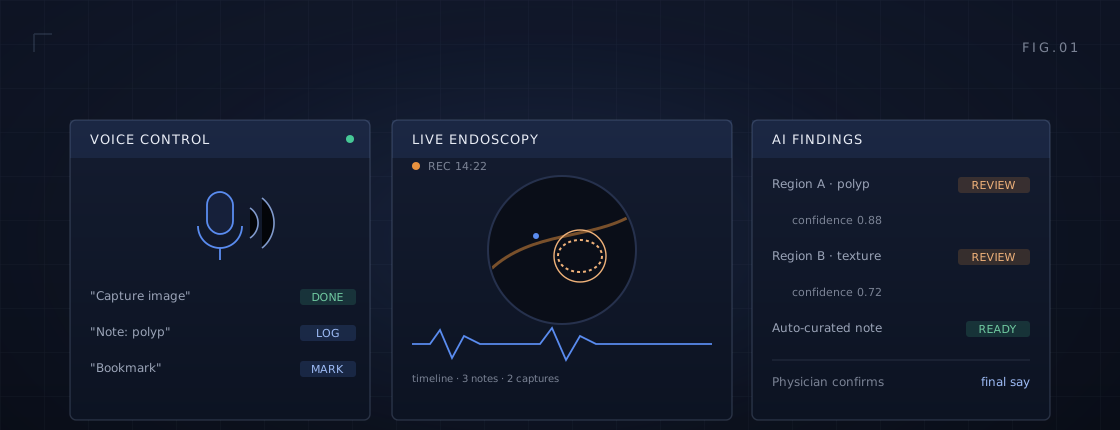
We built a hands-free platform driven by voice. Spoken commands capture stills, control recording, and attach notes in the moment; AI assembles the captures, audio, and notes into a curated procedure record and highlights regions that may warrant a closer look, which the physician reviews and confirms.
The system is an assistant and a scribe, never the decision-maker. It watches and records so the physician can keep operating.
The outcome
The platform now lets physicians run an endoscopic procedure entirely hands-free, capturing and noting by voice while AI curates the record and flags regions to review. Documentation that once ate into the day is produced in real time, findings are caught with a second set of AI eyes, and the physician confirms every one.
The surgeon keeps both hands on the scope. The platform handles everything else.
The same hands-free, AI-curated foundation extends to other procedure types and imaging modalities, new specialties plug into the voice-control, capture, and curation layers, so the record keeps getting richer without adding to the physician’s load.