
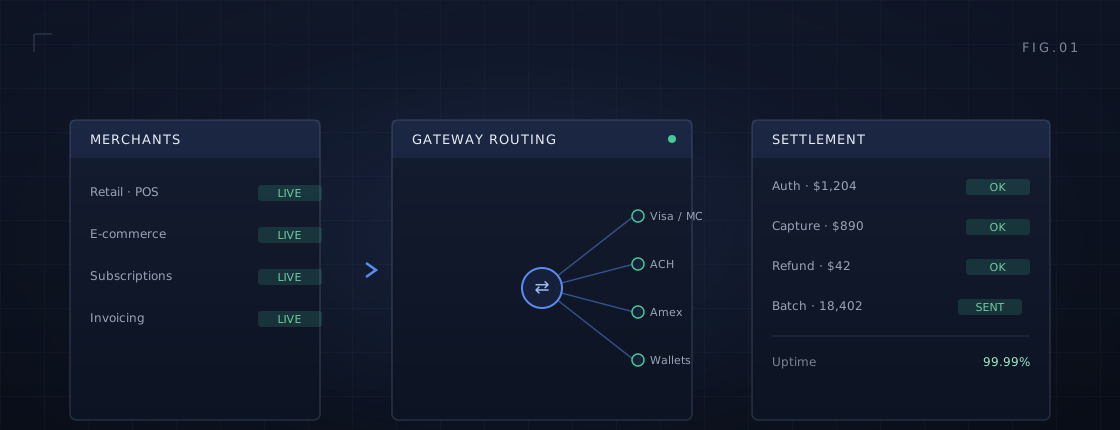
Every payment processor speaks its own dialect. For this merchant-services firm, that was the whole problem. Each new processor or card network meant another bespoke integration, months of engineering against a different API, a different settlement format, a different way of saying “approved.” Their merchant customers were effectively locked to whatever rails had already been wired in, and adding a new one was a project, not a setting.
Payments also leave no room for error: an integration that drops a transaction, double-charges, or fails to reconcile isn’t a bug, it’s a financial event. The system had to be both flexible and exact.
The challenge
Could the firm connect to many processors through one consistent interface, routing every authorization, capture, refund, and settlement reliably, so adding a rail became configuration instead of a months-long build, without ever losing or mis-stating a transaction?
The approach
We built a payment gateway integration layer that abstracts every processor behind a single interface. Merchants and internal systems talk to one API; the gateway handles routing, protocol translation, retries, and settlement, and reconciles every transaction end to end so the books always balance.
Payments don’t forgive ambiguity. The gateway’s whole job is to make many messy rails behave like one clean one.
The outcome
The firm now runs a dozen processors behind a single integration, moving over a million transactions a day at four-nines uptime. New merchants onboard in days instead of months, settlement reconciles itself, and adding a new rail no longer means starting a new project.
Complexity didn’t go away. It just stopped being the merchant’s problem.
The same gateway backbone extends to each new payment method as it emerges, a new wallet, network, or settlement scheme attaches through the adapter layer without disturbing the rails already carrying live volume.