
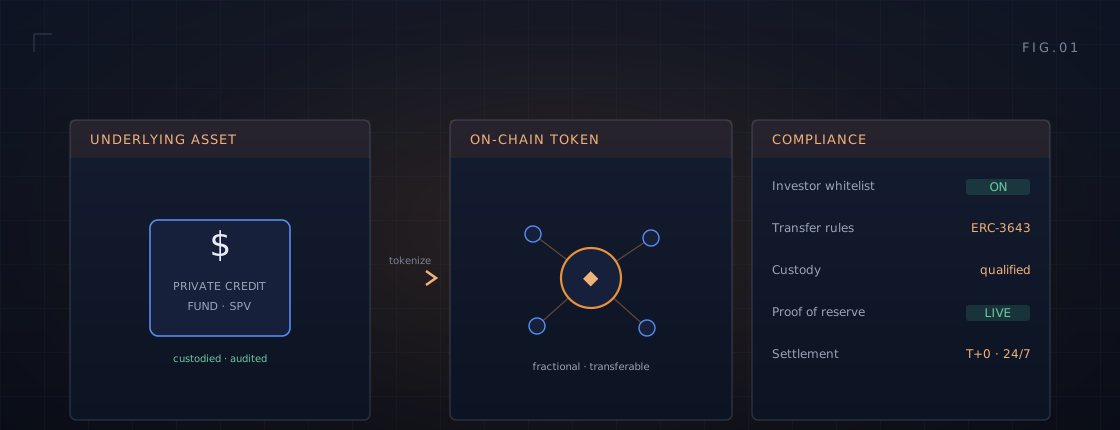
Tokenizing an asset is easy. Tokenizing it legally is the work. Putting a real-world asset on-chain is trivial if you ignore securities law, custody rules, and transfer restrictions. Doing it so that regulators, custodians, and investors are all satisfied is the actual engineering problem, and the one that determines whether the token is a demo or a financial instrument. We built for the latter.
The asset here was a private-credit fund: accredited investors wanted to hold and transfer fractional ownership on-chain, with the same protections and compliance they would have off-chain, and settlement that didn’t take days.
The challenge
How do you bring a private-credit fund on-chain, letting accredited investors hold and transfer fractional ownership, without breaking securities regulations, custody requirements, or the transfer restrictions that come with a regulated asset?
The approach
We issued a permissioned security token on the ERC-3643 standard, where compliance is enforced by the token itself: only whitelisted, verified investors can hold it, transfer rules execute on-chain, the underlying asset sits in qualified custody, and a live proof-of-reserve ties each token to the fund behind it.
The token is the easy part. We engineered the compliance, custody, and transfer rules that make it a real security.
The outcome
Tens of millions in private-credit assets are now tokenized and held by over a thousand verified investors, with onboarding measured in minutes instead of weeks and settlement collapsed from days to instant. Every transfer enforces the rules on-chain, and the proof-of-reserve feed keeps the backing transparent.
On-chain ownership without compliance is a liability. With it, it’s a market.
The framework generalizes across asset classes: real estate, receivables, or fund interests attach to the same whitelist, transfer-rule, custody, and proof-of-reserve stack, so the next asset is a configuration, not a rebuild.