In a trial, an unreviewed case is not just a delay, it is a finding waiting to happen. For this pharmaceutical company, the review and certification of trial cases ran on spreadsheets, email, and shared drives. Reviewers chased the latest version of a case, logged queries in one place and answers in another, and signed off in ways that were hard to reconstruct later. The work got done, but proving how it got done, to a sponsor, a QA team, or a regulator, meant reassembling a trail that was scattered across a dozen inboxes.
Clinical work lives and dies by traceability. Every review, every query, every certification has to be attributable, time-stamped, and defensible. The process the company had made good outcomes possible but made proving them painful.
The challenge
Could the company move the entire lifecycle of a trial case, intake, medical review, quality control, query resolution, and final certification, onto a single platform that enforced the workflow, captured compliant electronic signatures, and produced a complete audit trail by construction rather than after the fact?
The approach
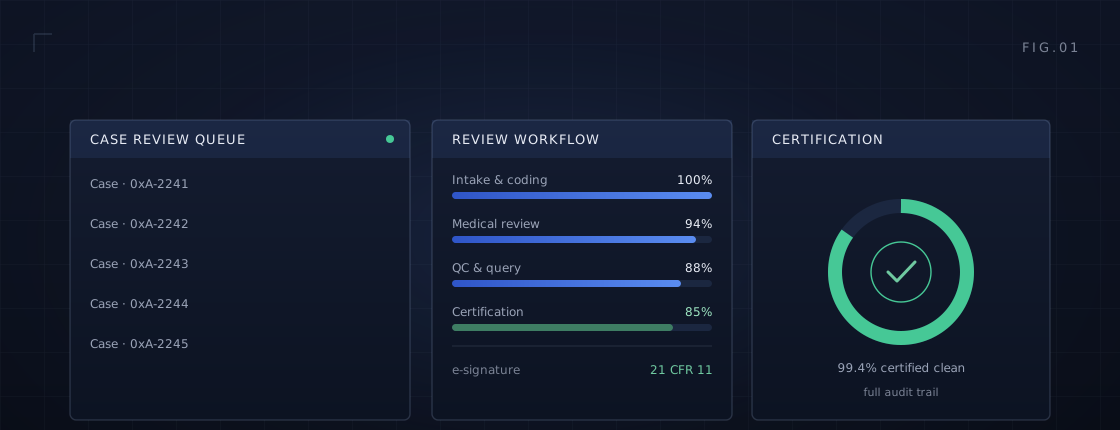
We built a platform that runs every trial case through a structured, enforced workflow. Cases are taken in and coded, routed through medical review and QC, queried and resolved in place, and certified with compliant electronic signatures, and every action is recorded to an immutable audit trail as it happens.
In clinical work, the process is the product. We made the right way to review a case the only way the platform allows.
The outcome
The platform now carries six figures of trial cases through review and certification, with cycle times cut by more than half and a near-perfect clean-certification rate. Queries resolve in place, sign-offs are compliant by default, and when QA or a regulator asks how a case was handled, the full history is one click away.
Traceability stopped being a burden. It became a byproduct of doing the work.
The same workflow-and-audit foundation extends to new case types and study designs, and lays the groundwork for AI assistance, surfacing likely queries, pre-coding cases, and flagging anomalies for the reviewer, on top of a process that is already controlled and inspection-ready.