
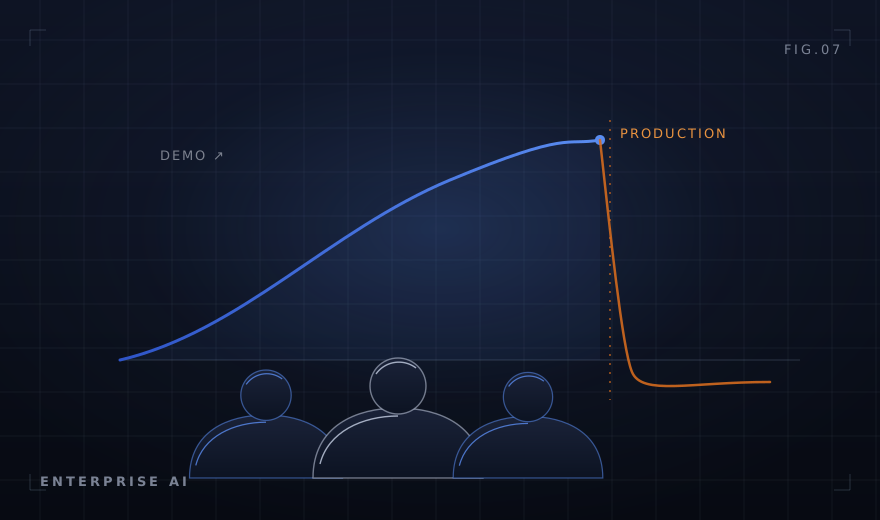
Every enterprise has the same drawer. It holds the slide decks from AI pilots that wowed a room. The chatbot that answered three perfect questions. The model that summarized a contract in seconds. The demo that made an executive say "ship it." And it holds the silence that followed, when "ship it" met reality and quietly died.
We've watched this happen across banks, utilities, and health systems, and the pattern barely changes. The things that make a pilot impressive are usually the same things that make it impossible to ship.
A demo optimizes for the room. Production optimizes for the world.
A pilot is a performance. It runs on cherry-picked inputs, a clean dataset someone prepared the night before, and a human quietly steering around the rough edges. None of that survives contact with real users, real data, and real volume.
The demo answers one question: could this work? Production answers a harder one. Will this keep working, for everyone, every day, without someone watching it? Those are different engineering problems, and most pilots never start the second one.
The pilot proved the model was capable. It said nothing about whether the organization was.
The five things the demo skipped
When a promising pilot stalls, it's almost never the model. It's the absence of the unglamorous scaffolding that turns a capability into a system:
- Data that isn't hand-fed. The pilot ran on a curated sample. Production needs a live pipeline into messy, governed, permissioned enterprise data, and that pipeline is most of the work.
- Integration into real systems of record. A great answer that can't write back to the CRM, the EHR, or the ledger is a parlor trick. The value lives in the workflow, not the chat window.
- Evaluation and guardrails. "It looked right in the demo" is not a quality bar. You need testing, monitoring, and the ability to know it's wrong before a customer does.
- Security, identity, and compliance. In regulated environments, AI has to clear the risk team before it clears the demo. Retrofitting governance costs far more than designing for it.
- People who will actually use it. Adoption is a discipline, not an afterthought. A system nobody trusts or understands is shelfware, however good the model.
A pilot tells you the ceiling. Production is the floor you have to build to reach it.
What to do differently
The fix isn't to stop piloting. It's to pilot the hard part. Instead of proving the model can produce a good answer, which in 2026 it almost always can, prove that you can get one good answer into production, end to end, for a single narrow use case. Wire the data. Pass the security review. Put it in front of ten real users. Measure whether they keep coming back.
That's a less dazzling demo. It's also the only kind that ships. The teams that win with AI aren't the ones with the most impressive pilots. They're the ones whose pilots were built, from day one, to become production systems.
If your drawer is filling up with decks, the question to ask isn't "which model should we try next?" It's "what did we never build the first time?"